AI governance is no longer a technical challenge, it’s a business one

Dougall Winship
Senior AI & Software Engineer
Published:
AI governance has traditionally been seen as a technical concern… something owned by data teams, security, or IT.
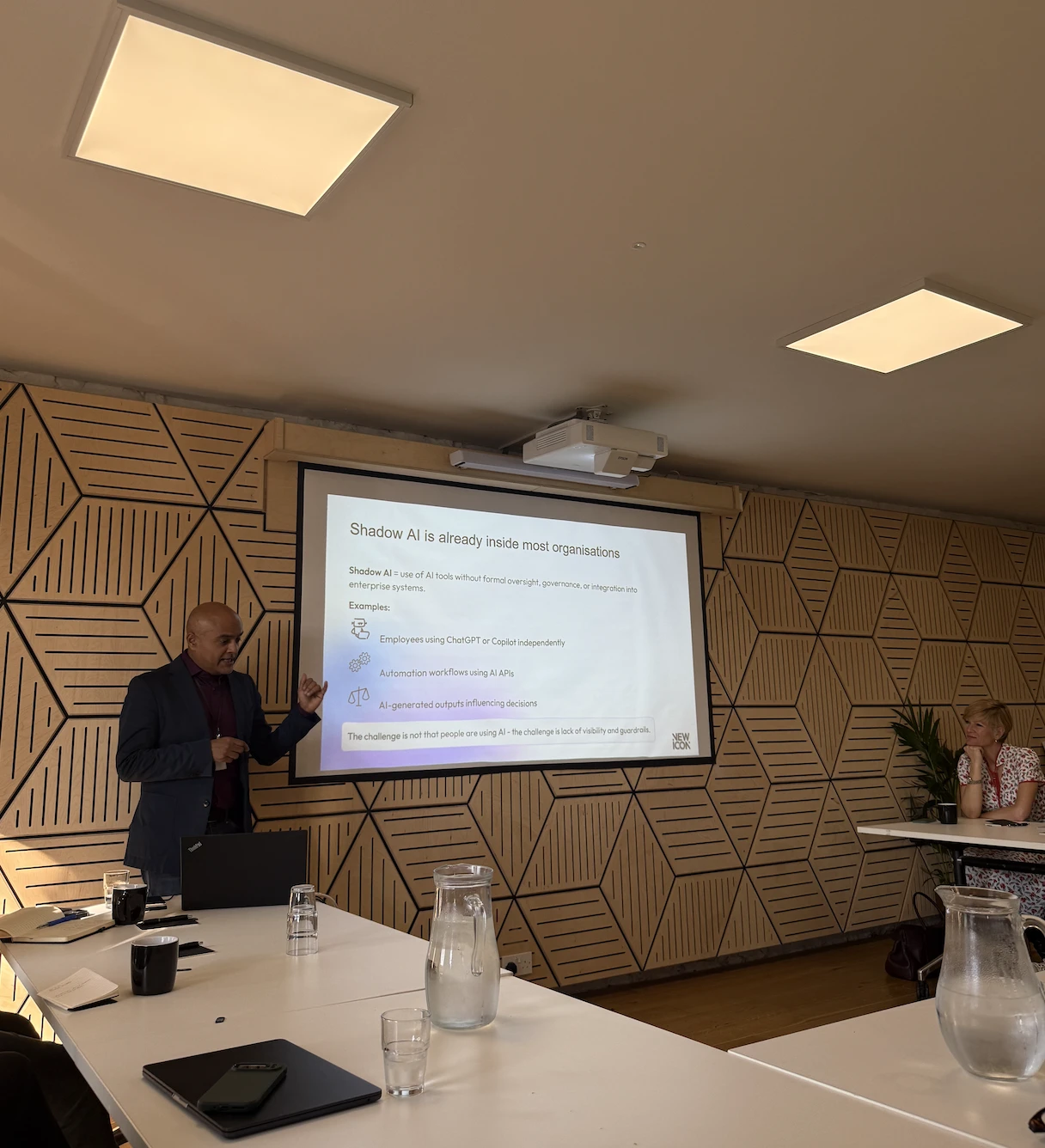
But that framing is starting to break down. At our recent AI governance roundtable in Bristol, one thing became clear very quickly: the organisations making real progress aren’t treating AI governance as a technical layer. They’re treating it as a business priority.
AI is no longer just supporting systems, it’s shaping decisions
AI isn’t sitting quietly in the background anymore, it’s influencing how decisions are made, how workflows are structured, and how outcomes are delivered across the business. That shift changes the nature of risk - it’s no longer just about where data is stored or whether systems are secure, it’s about whether the decisions being made can be trusted, understood, and explained when it matters.
The discomfort isn’t technical, it’s organisational
One of the strongest themes from the discussion was a growing sense of unease at leadership level - not because AI is being used but because it’s being used in ways that aren’t fully understood.
There’s often a lack of clarity around where AI is actually being applied, what data is feeding into it, and how outputs are generated. More importantly, there’s uncertainty around accountability. When an AI-influenced decision is made, who ultimately owns the outcome?
These aren’t technical edge cases, they’re fundamental business questions.
Why treating governance as “just IT” creates risk
When AI governance is owned purely within technical teams, a gap begins to form. AI continues to be adopted across the organisation, often in small, incremental ways but without clear alignment to broader business processes, risk frameworks, or decision-making structures.
Over time, that creates friction. Decisions become harder to explain, data is used inconsistently, ownership becomes blurred and confidence at leadership level starts to erode.
In some cases, organisations slow down because they don’t trust the systems in place. In others, they move forward too quickly, placing blind trust in outputs that haven’t been fully interrogated. Neither is sustainable!
Governance needs to reflect how organisations actually operate
A key takeaway from the roundtable was that AI governance cannot sit in isolation, it needs to extend the foundations that already exist across the business.
That includes data governance, security, risk management, and operational processes. But just as importantly, it needs to reflect how people actually work day to day.
If governance only exists in policy documents, it won’t hold. It needs to show up in real workflows, in how teams use tools, and in how decisions are made.
The organisations moving forward fastest
What stood out in the discussion was that the organisations making progress aren’t the ones trying to control everything upfront. They’re the ones bringing governance into leadership conversations early, aligning technical and business perspectives, and focusing on how AI impacts decisions rather than just systems.
They’re not aiming for perfect frameworks from day one. They’re building clarity, establishing guardrails that people can actually follow, and evolving their approach as usage develops.
There’s a recognition that governance isn’t a one-off exercise, it’s something that needs to adapt alongside the technology and the organisation itself.
A more useful starting point
One of the more interesting shifts in thinking is moving away from the question, “How do we govern AI systems?”
A more practical question is: how do we ensure that decisions influenced by AI are transparent, accountable, and aligned with the business?
That reframing brings governance out of a purely technical context and places it where it belongs, at the centre of how the organisation operates.
Final thought
AI governance isn’t about slowing things down. Done properly, it enables organisations to move faster, with greater confidence in the decisions they’re making and the systems they’re relying on.
And that’s why it can’t sit with just one team.
It’s a business responsibility.
Dougall Winship
Senior AI & Software Engineer
Dougall is a Senior AI & Software Developer at New Icon with extensive experience across software engineering, web and mobile development, and AI. He holds a first-class degree in Computer Science and has twice received recognition from the British Computer Society, bringing a strong technical foundation to building and evolving complex digital products and systems.
